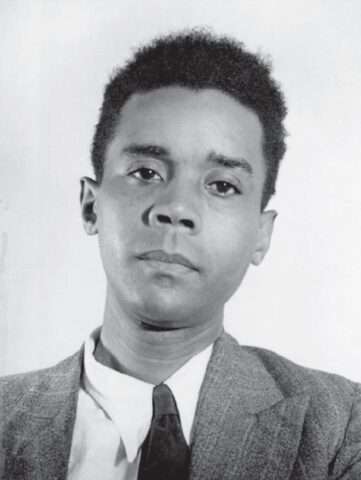
Picture from wikipedia
Today we commemorate the birth of Cyril Lionel Robert James, a titan of revolutionary thought and a foundational figure in the tradition of Marxist-Pan-Africanism. Born on 4 January 1901 in Tunapuna, Trinidad, James dedicated his life to articulating and advancing the inseparable cause of global working class emancipation and anti-colonial liberation. His work stands as a profound correction to Eurocentric Marxism, insisting that the struggle of the Black people and colonised peoples generally was not a secondary concern but the very vanguard of the world socialist movement.
James’s intellectual journey began within the contradictions of the British colonial education system, which provided him with the tools of Western literature and history while he lived under a regime that denied basic rights to his people. This early experience forged a critical perspective that would define his life’s work. His move to England in 1932 placed him at the centre of the period’s great political ferment amidst economic depression and the rising fascist threat. He engaged deeply with the revolutionary movements of the time, contributing significantly to the International African Service Bureau where he collaborated with other seminal figures like George Padmore. This period was crucial for developing his unique synthesis of Marxist internationalism and unyielding anti-imperialism.
His literary and theoretical output constitutes a formidable arsenal for the left. His seminal work, The Black Jacobins: Toussaint L’Ouverture and the San Domingo Revolution (1938), is not merely a historical account but a pioneering materialist analysis that positioned the enslaved Africans of Haiti as the most advanced revolutionary force of their age. James masterfully demonstrated how their successful insurrection was a central event in the making of the modern world, a direct challenge to bourgeois historiography and a timeless lesson in mass revolutionary praxis. In World Revolution 1917-1936: The Rise and Fall of the Communist International (1937), he provided a critical analysis of the Communist International, tracing its development and its challenges in fostering a genuine global revolutionary movement. His philosophical rigour is further displayed in works like Notes on Dialectics (1948), a demanding study aimed at training the revolutionary mind in a dynamic, non-mechanistic understanding of Marxist theory, focusing on the self-mobilising potential of the working class. Even his cultural criticism, such as Mariners, Renegades and Castaways: The Story of Herman Melville and the World We Live In (1953), written during his unjust detention on Ellis Island, served as a radical exegesis, reading classic literature as an allegory for the alienating forces of capitalist modernity.
James’s political activism was as innovative as his writing. In the United States, he worked within and through various Marxist organisations, consistently focusing on the autonomous power of the working class. With collaborators, he produced groundbreaking analyses like The American Worker, which documented the everyday resistance on the shop floor, from wildcat strikes to subtle acts of sabotage, seeing in these actions the inherent rebellion against capital and the seeds of a future socialist society. His commitment was always to the self activity of the people, whom he viewed as the true authors of history.
His Pan-Africanist work was the international extension of this principle. James was a key intellectual architect of the 1945 Fifth Pan African Congress in Manchester, a historic gathering that marked a decisive turn from petitioning to a doctrine of mass anti colonial struggle. He served as a mentor and influence to a generation of independence leaders, most notably Kwame Nkrumah of Ghana, imparting a vision of liberation rooted in popular sovereignty and socialist development. Throughout his later years, James remained an engaged interlocutor for liberation movements across Africa, the Caribbean, and within the Black diaspora, seeing in their struggles the same spirit of self-determination he had chronicled in San Domingo.
The legacy of C.L.R. James is a living, breathing guide for contemporary struggles. He taught that the revolutionary energy of the oppressed, particularly the Black working class in the colonies and metropoles, is the primary motor force for overturning the imperialist world order. He understood socialism as the direct, democratic rule of the working people themselves, and he approached culture as a vital terrain of ideological contestation and potential liberation. On the anniversary of his birth, we honour James not as a relic of the past but as a comrade whose work remains an essential compass for navigating the ongoing battles against capitalism, racism, and imperialist domination. His life reaffirms that the collective struggle for a just and equitable world is the only history worth making.